
Reconstruct Bullitt's Former Owners
No single parcel card lists every former owner. Begin at the newest deed, name its grantor, and then find the earlier deed where that same grantor received the land. Repeat while the legal description keeps matching.
| Transfer date | Grantor to grantee | Deed type | Book/page |
|---|---|---|---|
| Newest date | Prior owner to current grantee | Read instrument | Current locator |
| Earlier date | Earlier grantor to prior owner | Read instrument | Prior locator |
| Continue back | Repeat by former grantee name | Keep exact type | Preserve link |
| Historic era | Index lead to book image | Verify original | Archive locator |
Treat this as a working template, not a real parcel's chain. Fill each row from an actual deed image. A tax bill name or sale field never substitutes for a recorded transfer.
Bullitt Ownership Records by Era
Microfilm covers Bullitt County deeds from 1797 to 1902, 1966 to 1999, and 2009 to 2015. Original deeds fill the 1903 to 1966 span. The KDLA land inventory describes these archived holdings, not what the live clerk portal displays.
| Source | Documented range | Use for prior owners |
|---|---|---|
| County Clerk | Current cutoff not verified | Newest instruments |
| KDLA microfilm | 1797-1902; 1966-1999; 2009-2015 | Earlier deed images |
| KDLA originals | 1903-1966 | Original-record bridge |
| Museum index | Early books A-T | Discovery aid |
Check with the clerk before relying on any year. No published cutoff defines how far the online Bullitt County deed index reaches, so confirm rather than assume.
Walk Bullitt's Deed Chain Backward
The Bullitt County Clerk's record search opens with separate citizen and commercial entries, and its embedded controls and year ranges take some exploring. Work from names and book-page facts you already have.
- Find the current grantee's purchase deed and copy its legal description.
- Read the grantor and any prior-deed recital.
- Search that grantor as a grantee, testing initials and spelling variants.
- Compare the land description. At an online gap, continue through deed books, KDLA, and museum indexes.
- Grantor
- The party conveying an interest.
- Grantee
- The party receiving it.
- Chain of title
- Linked instruments for the same land.
- Reverse index
- The grantee side used to trace acquisition.
- Quitclaim and warranty deed
- Different conveyance forms whose terms must be read.
Bullitt's Missing Deed Book J
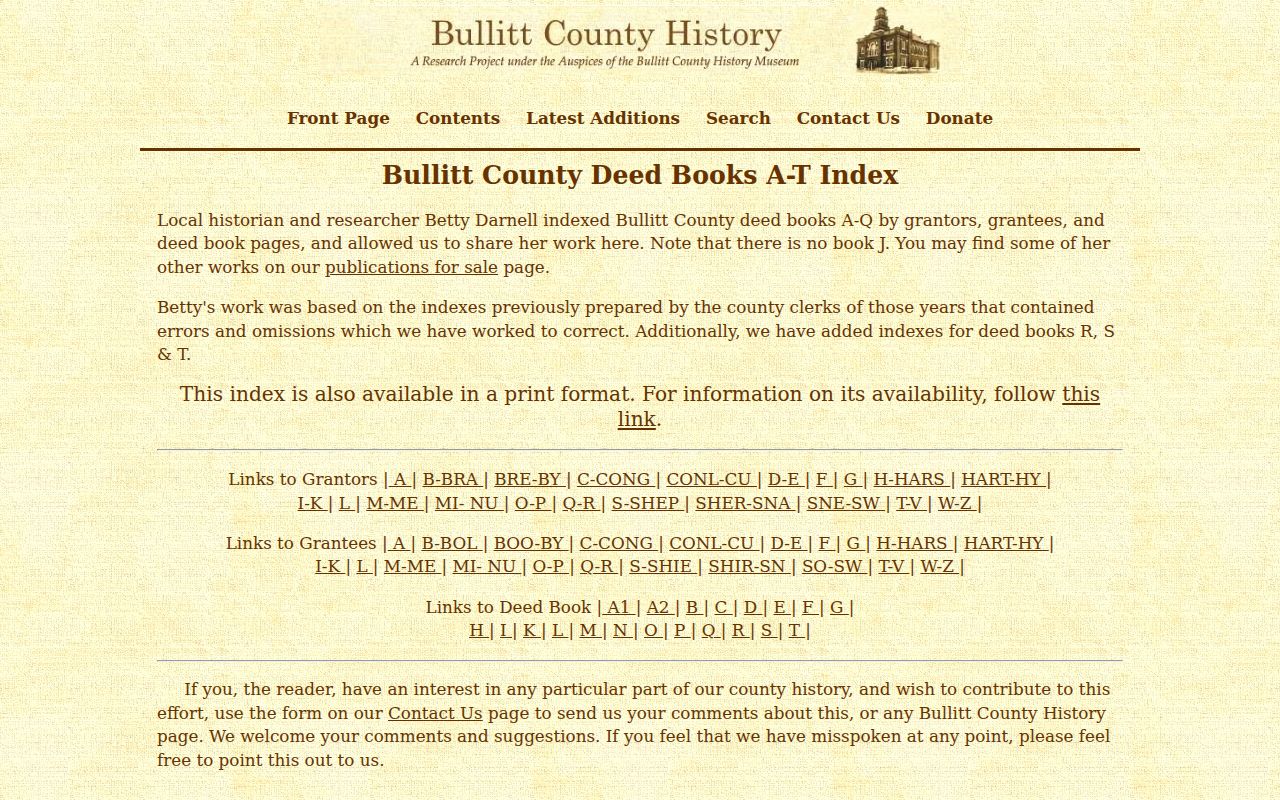
The History Museum's online A-T deed index lists Bullitt deed books but skips Book J entirely in its linked sequence. Museum staff note that older indexes received corrections for errors and omissions. That makes the index strong for discovery. It is not final proof. A party, book, and date lead can come straight from the index.
Carry every lead to the clerk or archive image and compare the legal description. A missing letter proves nothing about whether a deed existed.
Bullitt Prior Owners Beyond Addresses
Bullitt's grid uses KY 61 and KY 44 as its base. It also has a 1985 reference point. An old rural route number rarely matches a modern street label. Early deeds never will. Search instead by acreage, roads, creeks, and survey calls. Try adjoining owners, subdivision, lot, plat, and the prior deed cited. Keep PIDN punctuation exact for modern records. The legal description remains the bridge across a parcel split or street change.
Bullitt Plats Reconcile Parcel Splits
The museum's T.C. Carroll plat index holds 531 slide or set entries. It can surface a subdivision, landowner, or map reference where the GIS map shows nothing. Verify every hit in the clerk's plat and deed records. Shepherdsville's historic lots demand extra care. The 1793 town plan and the 1809 Shanks resurvey numbered lots differently, so record the plan, lot, addition, and nearby lots before matching a modern parcel.
Estates Interrupt Bullitt Owner Chains
Not every former owner sold the land. Some passed title through an estate, executor, administrator, heirs, court order, or fiduciary deed. When the deed line jumps in Bullitt County, do not assume a break. Search probate and court material first. Never insert a presumed heir without an instrument. Mortgages, releases, liens, and lis pendens belong in a separate chronology. Only a record that conveyed the land interest counts toward the owner of record.
Bullitt Archives Extend Ownership History
The Bullitt County Public Library keeps newspapers, microfilm, databases, and Family Files for local history. The museum holds deed, plat, survey, will, and map indexes. KDLA catalogs deed, will, tax, order-book, and court series. Each adds leads; the deed image verifies the transfer. FamilySearch images may require a login or a center visit, so log the source type, span, access limits, and your confidence beside every former owner.
Bullitt Clerk Copy Fallback
When the online index will not render, the clerk's copy process offers a direct route. A written request should carry the grantor, grantee, book and page, and recorded date. Those identifiers matter. Log every backward-chain step with its identifiers before moving deeper into the past. Plain copies run $1.50, excluding mortgage and certified copies. Mortgage copies cost $5. Certified copies cost $5 for the first three pages plus $0.50 for each added page, so confirm fees before paying. A copy request retrieves one known instrument. It never builds the chain for you. If KDLA holds the needed historic volume, verify its access format and transfer limits, because the inventory does not promise an online image for every volume.
Bullitt Names Need Reverse Checks
Former owners hide under initials, full names, changed surnames, spelling variants, co-owner forms, and fiduciary titles, so check both the grantor and grantee sides of the Bullitt County index. Preserve punctuation and capacity as displayed. A same-name entry joins the chain only after the legal description and dates fit. Deeds can change acreage after a split. A later deed may also cite an earlier survey. Compare parent and child tracts, adjoining owners, road and creek calls, lot and block, and the plat reference. Never treat the modern address as sole proof. The museum notes corrections to old index errors, which can surface a missed lead. The linked book image remains the final check.
Log Bullitt Prior Owner Evidence
For every transfer in the chain, write down the recording date, deed date, grantor, and grantee. Add the instrument type, the book and page or file number, the legal description, any consideration shown, and plat or prior-deed references. Also note the source. Was it an index result, an image, a plain copy, or a certified copy? That detail matters later.
Keep unresolved branches in view. An estate case may explain a gap. A deed might convey only part of a tract. A quitclaim can pass just the grantor's interest, and a correction deed can fix names or land text without being a fresh sale at all.
The log keeps your list of previous owners reproducible. It also shows the exact point where the chain of title stops.
Old Bullitt Tax Books Support Deeds
Tax lists and assessment books can place a name near land between deed events. But treat them as support. KDLA shows gaps in the early assessment series. FamilySearch catalogs Bullitt tax lists for 1797 to 1804, with possible access limits. A tax entry should never be recast as a transfer of ownership.
Use the tax books to test residence, acreage, district, or name continuity. Then go back to the deed, will, order book, or probate file that explains the change. Newspaper notices from the library can add dates and sale context. But they never replace the clerk's instrument.
This layered approach helps most when a former owner held a rural tract long before modern parcel numbers existed. It also shows how confident each historical claim really is.
How Far Bullitt Ownership Goes
KDLA traces Bullitt deeds back to 1797, wills to 1803, and order books to 1797 as well. The historic series are uneven, and assessment books have gaps. A missing year may simply mean another volume or repository holds the evidence you need.
Online cutoff unverified. Continue beyond the clerk portal through deed books, KDLA, and local indexes. Use former-owner facts only for lawful land and house history.
Never force the chain past the evidence. Record the last verified deed, the missing range, spelling variants, and which archive you checked. The deed records page covers ordering a single instrument. This page stays on time depth. A defensible stopping point beats adding a former owner on a surname, a tax mention, or a nearby tract alone.